
PipingNotes

Design-Engineering-Construction-Testing & Commissioning of piping

Browsing:

Category: Notes

Note#102

Relief Valves

 The required relief area for two-phase flow is typically two to ten times the area for single-phase flow.

 For spring-operated relief valves, small amounts of leakage start to occur at 92–95% of the set pressure.

 A relief devices over-pressure is the pressure increase over its set pressure, usually expressed as a percentage of the set pressure. Pop-acting relief valves do not immediately open completely (to 100% lift). Sufficient over pressure is necessary to achieve full lift.

 if the vessel is protected by multiple relief devices, then one relief device must be set no higher than the MAWP but the others can be set as high as 105% of the MAWP.

Note#101

High pressure may result from the failure of a control valve, a reaction that is out of control, thermal expansion of a liquid, or even an external fire.


Note#100

by increase the flange class inner diameter and diameter of the raised face at all the same; but outside diameter, bolt circle and diameter of bolt holes become larger in each higher pressure class.


Note#99

Flanges can withstand different pressures at different temperatures. As temperature increases, the pressure rating of the flange decreases


Note#98

Slug Flow is typical two phase flow where a wave is picked up periodically by the rapidly moving gas to form a frothy slug, which passes along the pipe at a greater velocity than the average liquid velocity.


Note#97

Data required for flexibility calculations
1. Code of Practice
2. Basic Material of Construction of Pipe
3. Ambient / Installation temperature
4. Number of Thermal Cases
5. Flexibility Temperature (See Note)
6. Design Pressure
7. Outside diameter of Pipe
8. Type of construction of pipe
9. Nominal Thickness of Pipe
10. Manufacturing tolerance
11. Corrosion allowance
12. Pipe Weight
13. Insulation Weight
14. Specific Gravity of Contents
15. Young’s Modulus at Ambient/Installation Temperature
16. Young’s Modulus at Flexibility Temperature
17. Thermal Expansion at Flexibility Temperature
18. Allowable stress at Ambient/ Installation temperature
19. Allowable stress at flexibility temperature
20. Bend radius and type of bend
21. Branch connection type
22. Weight of attachments – Valves and Specialties
23. Terminal movements with directions


Note#96

Types of fluid service according to B31.3
(a) Category D Fluid Service: a fluid service in which all the following apply:
(1) the fluid handled is nonflammable, nontoxic, and not damaging to human tissues as defined in para.300.2;
(2) the design gage pressure does not exceed 1035 kPA (150 psi);
(3) the design temperature is from −29°C (−20°F) through 186°C (366°F).
(b) Category M Fluid Service: a fluid service in which the potential for personnel exposure is judged to be significant and in which a single exposure to a
very small quantity of a toxic fluid, caused by leakage, can produce serious irreversible harm to persons on breathing or bodily contact, even when prompt restorative
measures are taken
(c) High Pressure Fluid Service: a fluid service for which the owner specifies the use of Chapter IX for piping design and construction; see also para. K300
(d) Normal Fluid Service: a fluid service pertaining to most piping covered by this Code, i.e., not subject to the rules for Category D, Category M, or High
Pressure Fluid Service


Note#95

Pressure gauge normally indicates the difference between the measured pressure (absolute pressure) and atmospheric pressure.


Note#94

On the long term negative effects of rusting on steel valves will reduce the structural integrity of the valve, since rust has different physical characteristics than steel


Note#93

For constant flow-rate, when the velocity increase the flow cross section decrease


Note#92

Zinc, aluminum and magnesium are more electronegative than steel they are increasingly able to supply electrons to the more electropositive steel when in electrical contact in water,


Note#91

Cathodic protection may be achieved in either of two ways. By the use of an impressed current from an electrical source, or by the use of sacrificial anodes (galvanic action).


Note#90

You can protect piping which in contact with the ground or routinely contains fuel by one of the following methods


Note#89

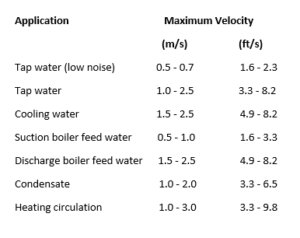
The fluid flow velocities in water systems should not exceed certain limits to avoid noise and damaging wear and tear of pipes and fittings. The table below can be used as guidance to maximum velocities:


Note#88

For submarine pipeline systems default corrosion allowance = 10 mm


Note#87

For carbon steel piping, default corrosion allowance = 3 mm


Note#86

A gas system is defined wet when the relative humidity exceeds 50 %.


Note#85

Bolt torque tables should be obtained from the manufacture of gaskets


Note#84

Rating is maximum allowable operating pressure


Note#83

Corrosion resistance of stainless steel due to minimum 30% chromium in its content