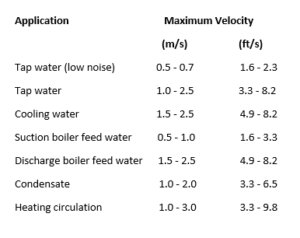
The fluid flow velocities in water systems should not exceed certain limits to avoid noise and damaging wear and tear of pipes and fittings. The table below can be used as guidance to maximum velocities:

Design-Engineering-Construction-Testing & Commissioning of piping

The fluid flow velocities in water systems should not exceed certain limits to avoid noise and damaging wear and tear of pipes and fittings. The table below can be used as guidance to maximum velocities:

A maximum variability factor of 25% has been established by MSS to limit the load differential which may be prescribed in a variable spring support
Travel stops are installed in all constant spring support before shipping. These must be present during any hydro testing, but must be removed during installation before normal operations
Weight of water in pipes filled with water can be calculated as
ww = 0.3405 di 2 (3)
where
ww = weight of steel pipe filled with water (Pounds per Foot Pipe)
di = inside diameter (inches)
Weight of Empty Steel Pipes
Weight of empty steel pipes can be calculated in imperial units as
wp = 10.6802 t (do – t) (2)
where
wp =weight of steel pipe (Pounds per Foot Pipe)
t = pipe wall thickness (Inches)
do = outside diameter (inches)
Or. alternatively in metric units
wp = 0.02464 t (do – t) (2b)
where
wp =weight of steel pipe (kg/m)
t = pipe wall thickness (mm)
do = outside diameter (mm)
Cross Sectional Area
Cross-sectional Area of a Steel Pipe can be calculated as
A = 0.785 di 2 (1)
where
A = cross-sectional area of pipe (Square Inches)
di = inside diameter (inches)
Design pressure safe for short occasional or short operating periods if higher than design pressure if loop pressure less than (Y SA max allowable pressure)
Y = 15% if event less than continuous 8 hrs/day or 800 hr/year
Y = 20% if event less than continuous 1 hrs/day or 80 hr/year
Maximum sustained pressure + occasional pressure + transient pressure less or equal design pressure by code